A Woman’s Life Saga
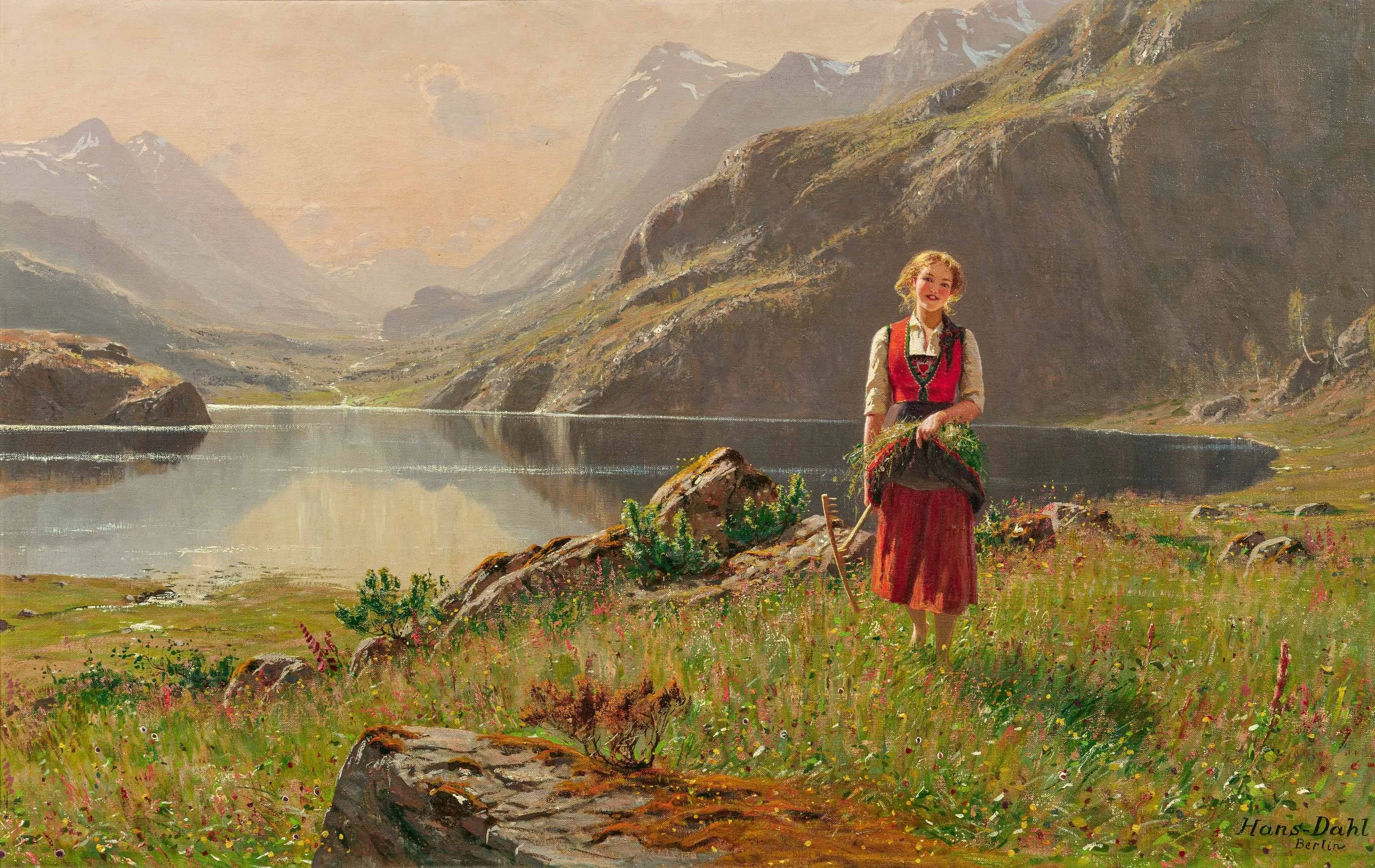
“A Young Girl in a Norwegian Fjord”, (1849 – 1937), Norwegian
"Through the great darkness that would come, she saw the gleam of another, gentler sun, and she sensed the fragrance of the herbs in the garden at world's end."
- Kristin Lavransdatter - The Wife, Sigrid Undset
Our human existence has lived to see many lengthy books written — from long narrative poems to thick, slightly frightening books of the Realists. Very often, I personally would say, those lengthy books, despite their frightening size, happen to be an enriching journey, for they often, embrace life so beautifully, so realistically, so simply and yet a reader closes the last page with a pleasant feeling or an epiphany, or perhaps, a need to rest and digest that which had been read. It is often said that such lengthy novels are "more real than life". The reason for it probably being in the fact, that us, humans, do not notice how rich and epic our lives are even when they are very simple. The battles we fight, the victories we obtain, the struggles we overcome, the joys we experience, they make each one of us a hero or a heroine, even though we do not notice it. Big novels which seemingly speak of nothing more but simple life, describing its details, remind us about how outstanding and full life is when one takes a different perspective on it.
"Kristin Lavransdatter" is one of such novels. One may say it is three separate novels, since it is written in three parts. Kristin Lavransdatter, is however, unique. It is the lengthy, realistic novel which portrays life in all of its glory, but the life narrated is life of a woman from her birth until her death. Kristin's creator, is also, a woman, a Norwegian authoress Sigrid Undset, born on 20th of May 1882 in Klaundborg, Denmark to a Danish mother and a Norwegian father. With a deep passion for Scandinavian Middle Ages, her first attempt at writing a historical fiction story was when she was only sixteen years old. The short novel, was however, refused by publishers. Kristin Lavransdatter was published between 1920 and 1922. The novel brought her a Nobel Prize. Besides being a unique perspective of woman's life, the novel was also praised for being an outstanding ethnographic portrayal of pre-Reformation Norway and Scandinavia.
The story, separated into three pieces, as mentioned above, wonderfully sections a woman's life into maidenhood, womanhood and eventually old age. Hopes, disappointments, expectations, faith and God are all present. We shall look at how this novel and its so intuitively masterful separation into three stages relates the three, archetypes of woman's life — Maiden, Mother, Crone.
The Wreath - The Maiden
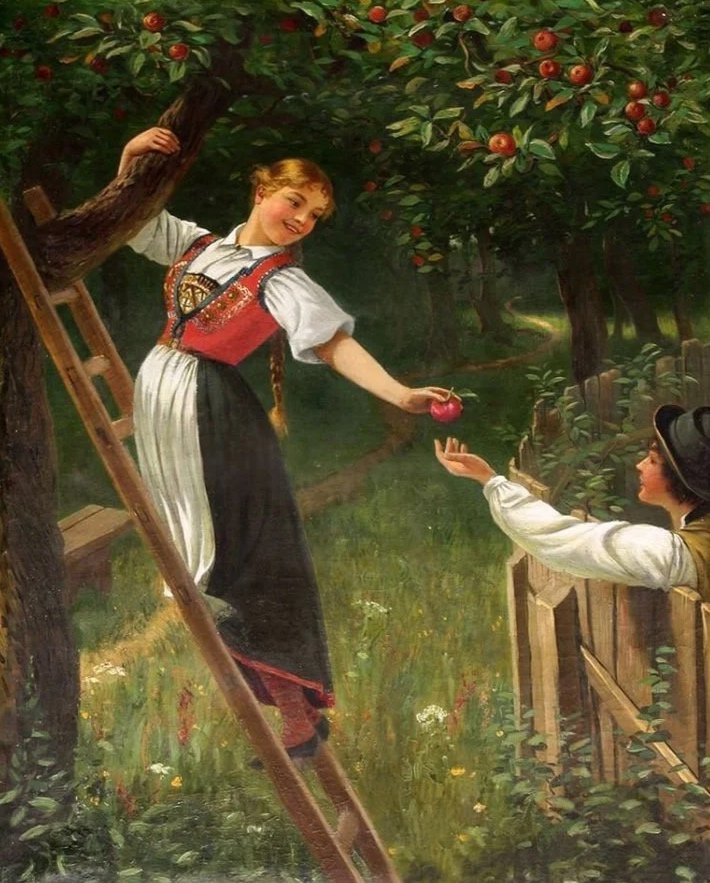
Art: "Apple Orchard", Hans Dahl (1849 - 1937), Norwegian
"They did not imagine that they might be stronger than the world. But if they had only known, they could have taken all the mountains and flung them out into the sea like tiny pebbles. No one and nothing can harm us, child, expect what we fear and love."
The above quote is an advice that the Brother Edvin offers to young and wild Kristin. The whole first part of the saga, which carries the title "Wreath" is dedicated to Kristin's maidenhood. As a young girl, Kristin is curious, strong and free willed. She is the wild spirit of Diana. She longs for experience and for an explanation of the world which surrounds her. She possesses natural sensuality and wit that she becomes aware of as the time progresses.
Kristin has a very close relationship with her father and a slightly distant relationship with her mother. The beginning of her initiation into the womanhood is the threshold at which she must make a choice. In order to do what feels right, she faces a big dilemma. The choice that she is inclined towards also means that she must disappoint the person who is closest to her and whose trust she fears most to lose - her father. This is the symbolic of woman leaving “her father’s house”, which while safe, grows emotionally impoverished.
When woman is a maiden she usually embodies one of the two archetypes — Persephone or Artemis. Persephone is the proper, well - behaved young girl, Artemis is a wild and self willed one.
Artemis or Diana is a lunar goddess of hunt, wilderness and animals. She is also a virgin and protector of young girls and maidens. The wild playfulness, the exploration of the wilderness and patronage over maidenhood is not a mere coincidence. These three, seemingly separate principles carry subtle connections. Kristin’s adventurous spirit bring her authentic experiences in which she encounters other mother figures, including the wise crones through whom she explores her own existence and place in society as a woman. Discovery of the individual potential, of her own sexuality and what she can do with it is an important part of the maiden's experience.
Kristin, despite the strictly religious society, pursues her curiosity and her desire by engaging in an intimate relationship with a man who is not her husband. When she is faced with the consequences of her choices, she is forced by the circumstances to leave the carefree exploration of maidenhood and enter the world of a mature, responsible and accountable women.
The Wife - The Mother
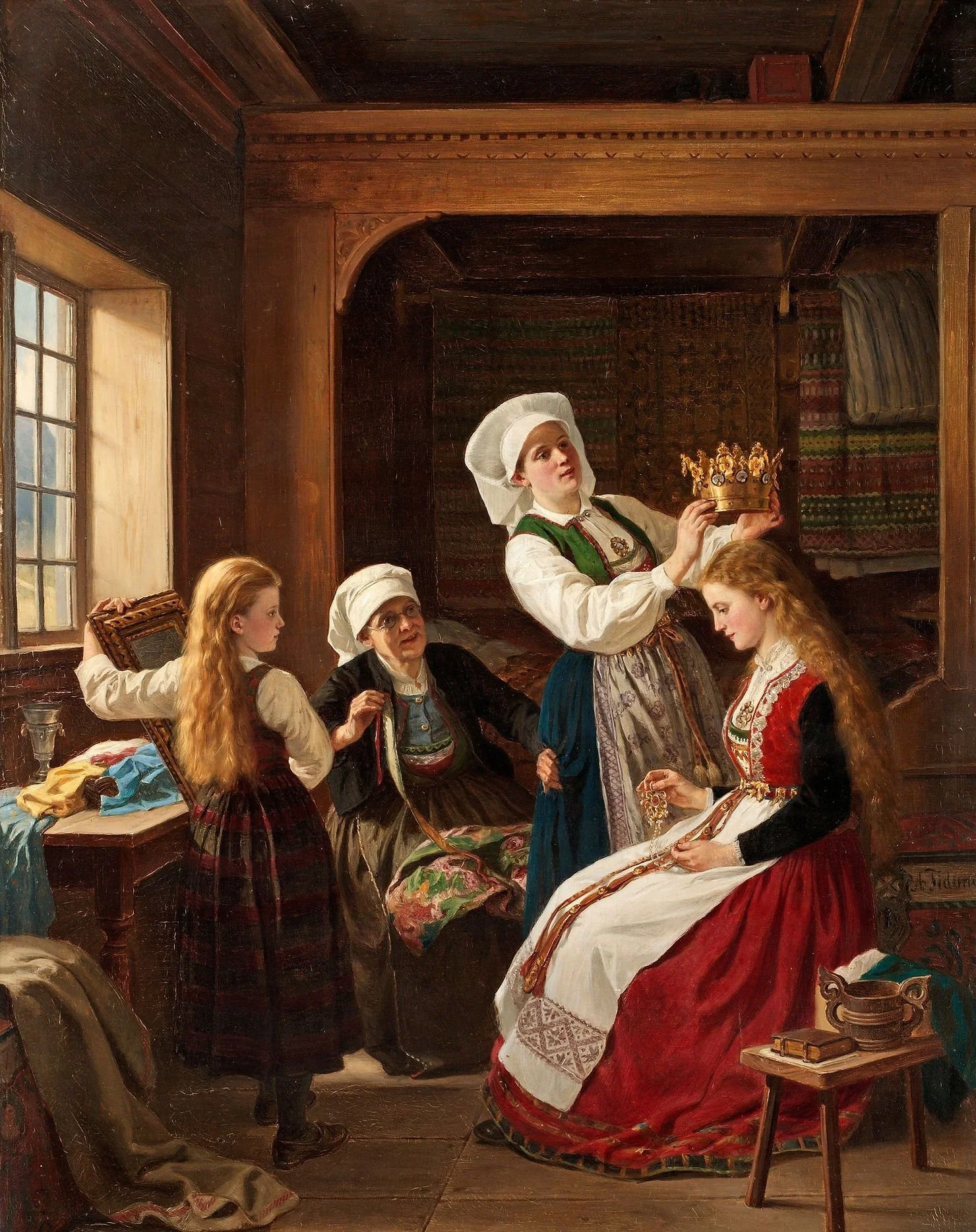
Art: "Brudepynting", Adolph Tidemand (1814 - 1876), Norwegian
"At sunset Kristin was sitting up on the hill north of the manor. She had never seen the sky so red and gold. Above the opposite ridge stretched an enormous cloud; it was shaped like a bird's wing, glowing from within like iron in the forge, and gleaming brightly like amber. Small golden shreds like feathers tore away and floated into the air. And far below, on the lake at the bottom of the valley, spread a mirror image of the sky and the clouds and the ridge. Down in the depths of the radiant blaze was flaring up-ward, covering everything in sight. (...) She sent a last sigh after her prayers; an appeal for forgiveness because her thoughts had been elsewhere while she prayed. The beautiful large estate lay below her on the hillside, like a jewel on the wide bosom of the slope. She gazed across alll the land she had owned along with her husband. Thoughts about the manor and its care had filled her soul to the brim. She had worked and struggled. Not until this evening did she realize how much she had struggled to put this estate back on its feet and keep it going - how hard she had tried and how much she had accomplished. She had accept it as her fate, to be borne with patience and straight back, that this had fallen to her. Just as she had striven to be patient and steadfast no matter what life presented, every time he learned she was carrying yet another child under her breast - again and again. (...) They were her children, these big sons with their lean, bony, boy's bodies, just as they had been when they were small and plump that they barely hurt themselves when they tumbled down on their way between the bench and her knee. They were hers, just as they had been back when she lifted them out of the cradle to her milk-filled breast and had to support their heads, which wobbled on their frail necks the way a bluebell nods on its stalk."
With a mixture of sorrow of a daughter who had to disappoint her family in order to pursue her individual path and happiness of a newly-wed bride, Kristin enters her new life phase. She has married the man she had desired more than she desired anything else in her life. Soon enough, are her maidenly illusions shattered — the man who she occasionally met to exchange beautiful passionate moments with is not the same man when she shares her daily life with him. She must learn to love not only the fantasy prince of her dreams but this man who is flawed and often reckless. She experiences a pregnancy after pregnancy. She goes through moments of happiness and fulfilment but also of guilt, doubt, loss and everything else life could bring.
Yet in spite of everything, she feels within her a quiet pride as expressed in the excerpt above. It is not an identification with how much she was able to endure, but rather a pride which appears after realisation that she cannot be broken. The strong willed, stubborn maiden still exists, but now she stands with a pride of a mature woman, a woman who governs, a woman with an authority and great responsibility.
The mother and queen archetypes (which often intersect), throughout cultures are countless The significance of these goddesses is far from a simplistic domestic role. They are the ones who transform pure potentiality into a concrete form and manifestation. They are the locus of existence of everything else. Through them everything comes to be. Joseph Campbell, in his famous interview with Bill Moyers, reminds of this concept: "Not only that, but then when you move to a philosophical point of view, the female represents what in Kantian terminology we call the forms of sensibility. The female represents time and space itself. She is time and space, and the mystery beyond her is beyond pairs of opposites, so it isn’t male and it isn’t female. It neither is nor isn’t, but everything is within her, so that the gods are her children. Everything you can think of, everything you can see, is the production of the goddess. "
The curious and wild creativity of maiden, in this stage, has evolved into a grounded, visionary creation. She is not a young girl curious to touch every flower. She, armed with her experience, reaches for the flower that she knows will allow her to create that which is good and noble and that which will endure for a long time. The impatience of a maiden has evolved into the patience of a woman who knows that flowers cannot bloom before spring. She nurtures the flower with patience.
Kristin, through her many pregnancies learns deep compassion resembling the compassionate Virgin Mary. It is something she struggles with the whole novel — she is highly individualistic and with a need for her own space and she finds motherhood challenging despite the deep love she feels for her sons. Kristin also learns to identify with her body in a yet another way. This time, not as the body of the lithe maiden but the body that has accommodated many pregnancies and fed just as many children — she finds beauty in it and is deeply proud of it.
The role of a powerful, calm, wise and grounded matriarch prepared her for the next, final stage of her life.
The Cross - The Crone
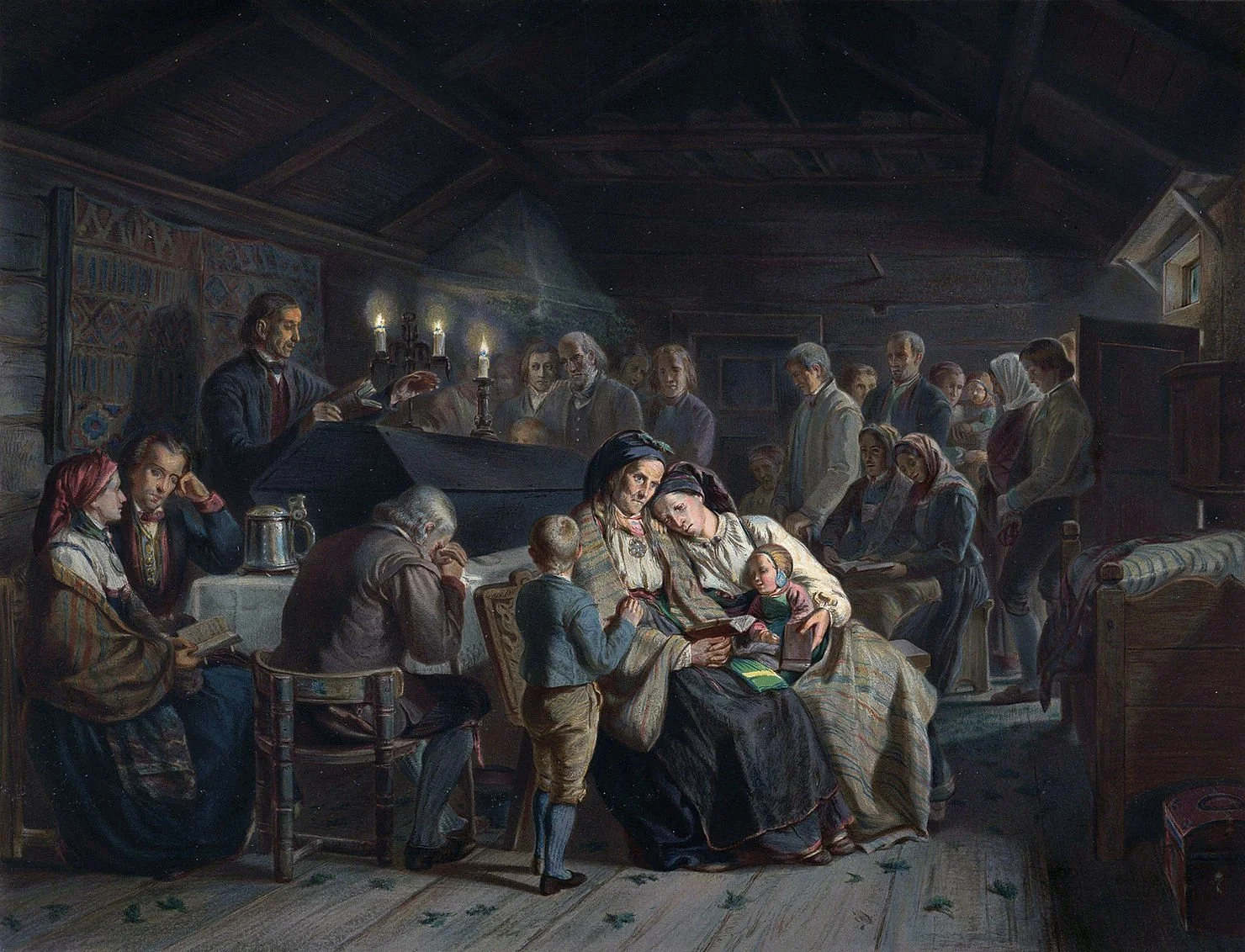
Art: "Et Gravöl", Adolph Tidemand (1814 - 1876), Norwegian
"She had finally come so far that she seemed to be seeing her own life from the uppermost summit of a mountain pass. Now her path led down into the darkening valley, but first she had been allowed to see that in the solitude of the cloister and in the doorway of death someone was waiting for her who had always seen the lives of people the way villages look from a mountain crest."
With death and marriages of her loved ones and children, Kristen, gradually begins to experience the almost inevitable aloneness of the old age. However it is not a time to idle either. After having completed the many tasks and responsibilities she had to take on as a young and later mature woman, she is left to complete the final steps of her journey. For the first time, after so many years, Kristen has time just for herself.
Sigrid Undset was a Catholic, and faith plays a significant role in her heroine's journey as well. She takes on a pilgrimage during which she not only meets fellow pilgrims, but also has significant insights. Finally, she is accepted as a corrodian, and later, she had promised to live a chaste life and obey the nuns. Finding a new community, especially, a community of women has allowed her to dedicate the last years of her life serving her community — doing good and sharing the wisdom and experience that her mind and body carried.
The sharing of wisdom and experience accumulated over the years with the community is exactly the crone's role. As a woman who has seen and experienced much, she possesses outstanding knowledge about humans and life. She is able to use that knowledge to guide or heal those around her who are in need of the wise old woman in their lives. It is a time during which she is both cultivating her own personal visions and passions, but also giving to others. She binds the community and brings significant and positive change to it. Even without a husband or children, she still has an important role and purpose both in her own life and in the lives of others.
By completing her heart's last wishes and giving back to the world that which she had learned from it, she is ready to leave the life on earth fulfilled and with no regrets on her deathbed.
