Knight in Shining Armour

"The Two Crowns", Sir Frank Dicksee (1853 - 1928), English
"In terms of western spiritual chivalry, the ideal role of the armed knight is to protect Love from violation by the World, the Flesh and the Devil, and to defend womanhood as Love’s symbolic fortress. "
- "Shadow of the Rose: The Esoterism of the Romantic Tradition", Charles Upton and Jennifer D. Upton
Tales of brave knights have for centuries been a part of Western literary and spiritual traditions. The concept of chivalry and chivalrous conduct and values exist, of course, across cultures. I have a habit of saying that whenever an idea, a concept or practice exist in a more or less similar manner in spite of individual uniquenesses and differences, it means that there is some truth in it that transcends cultural, national even formal religious borders. However, the intent of this text is not an anthropological investigation or comparison. For this article, the focus shall be on the Western tradition.
If a person has taken a literature class that person could have had chance to hear that chivalric ideal and knightly love came to be as a child of two traditions which were destined to meet on the territory of today's Europe. It is not hard to know which traditions are those two — one being Christian tradition, which values humility, obedience, devotion and divine love, the other being the one that spread with the expansion of Germanic peoples across the continent, the tradition which values a warrior, valor, strength, battle and victory. Some scholars also add the importance of Islamic and Arabic poets, especially those of Udhri tradition, as significant influence upon this tradition in the West.
The Anglo-Irish writer, Kenlem Henry Digby, in his work "Maxims of Christian Chivalry", brings a similar idea behind chivalry to the one expressed in the opening quote of this essay. He says: "What is Chivalry? Chivalry is only a name for that general spirit or state of mind which disposes men to heroic and generous actions and keeps them conversant with all that is beautiful and sublime in the intellectual and moral world." In both cases, it is obvious, that chivalry is not just about outer, superficial heroic acts, before anything, it is a state of mind or spirit. It is nobility of a man's soul that make him a knight.
The essence of a Traditional worldview is that while there is a point of unity and the shared centre, the individual differences exist and are not insignificant. The Divine is both the Unique and the One. While knights share the centre, they are also each very unique and different. Indeed, even the Knights of the Round Table are still different in character and in their unique paths. There is often the knight who is almost a poet, another who is more of a warrior, one who is deeply religious and many others and while each contains all, he embodies certain traits more visibly and his path is more clearly defined by it.
The tarot deck, even if one does not use it for occult practices and does not believe in them, has served as a good source of exploring archetypes for many. The tarot deck has four knights — cups, pentacles, swords and wands. We shall look at different well-known knights, their individual traits and see, how almost any man, with his unique individual constitution, can find a chivalric hero who in so many ways, was exactly like him.
The Knight of Cups
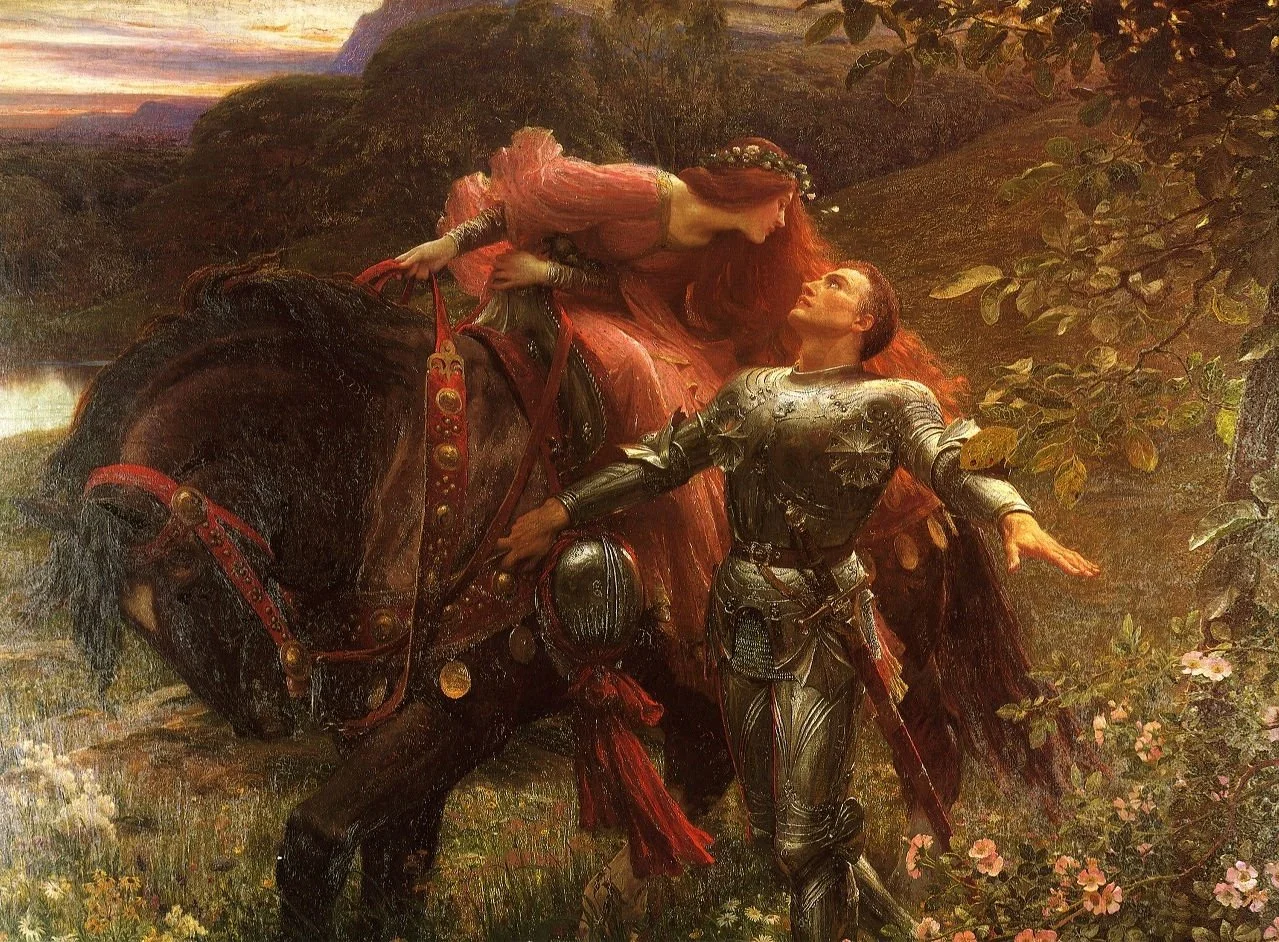
"La Belle Dame Sans Merci", Arthur Hughes (1832 - 1915), English
The romantic knight is probably the one that comes to people's mind first when they hear the word knight since in our modern time this knightly archetype or ideal has been merged with that of a prince charming. He is the romantic who writes poems, brings roses and is ready to do just about anything for his maiden. It does not mean, however, that the romantic knight is incapable of action — indeed, he very often does act, but his acts are motivated by love, beauty, poetry, idealism, and love. The lady is crucial in the story of any knight, of course, but each has unique approach to her. He is our knight of cups, the knight of the elemental water. Water seeks to merge, flow and feel.
This knight and be blind when it comes to love and is often willing to cause discord and chaos for his romantic pursuits. For the romantic knight, his relationship is the very meaning and purpose of his existence. He yearns that the expansive love within him finally finds someone who is willing to receive it.
Lancelot probably is the closest to this specific knightly archetype. He is also one of the most famous knights in the popular mind. Lancelot, although being King Arthur's greatest companion, has an affair with Arthur’s Queen, Guinevere. This love of his brings about a great tragedy — a civil war and the end to Arthur's Kingdom. However, it is not only the external tragedy that his romantic ideals had brought him — on the individual and spiritual level, Lancelot suffers greatly. He wanders as a madman through woods and he is only allowed a glimpse of the Grail. Finally, even his lady refuses him, blaming their affair for the great tragedy that happened, taking a life of penitence. Lancelot, follows her to hermitage, where he dies shortly after her death.
The knight of love, cannot live without love, but he has to learn to master his oceanic emotions so that his loves can truly flourish.
The Knight of Swords
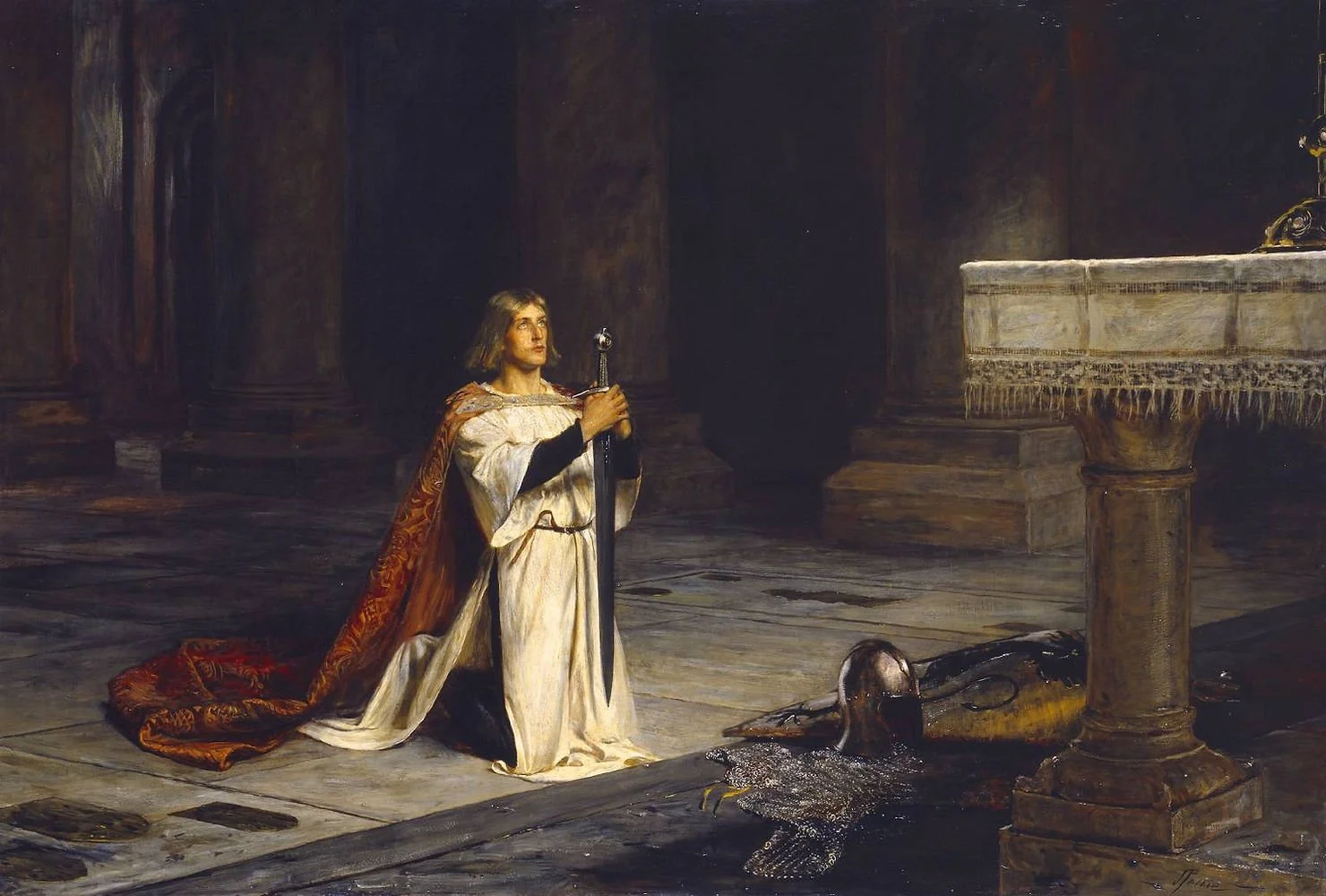
"Vigil", John Petite (1839 - 1893), Scottish
If the ideal of romantic knight is the one that stands behind the character of prince charming, then the individualistic, justice—seeking, slightly detached knight is behind much of heroes of the action, mystery or political drama films. He is often alienated from the common society but also possesses a great desire to move forward, to create a structural change and to do something good and just.
He is focused, persistent and very few things can keep him away from his path. Just like the sword that is precise and cutting so is he when he directs his energies. The deck of swords, in tarot, belongs to the elemental air, which is volatile in nature but once concentrated and directed, becomes a great force that moves everything around itself. Possessing these airy qualities, he's very intelligent and with many original thoughts.
Air and swords in a tarot deck bring challenges and anxiety. Air, flying above others and being invisible also tends to alienate a person. But air is also the element that connects everything since everyone breathes it. Air therefore makes one very individualistic, original, creative and investigative. This knight goes through challenges and isolation but on this journey he becomes vast, all-encompassing and finally obtains his beloved.
The one who comes to mind as an embodiment of this specific set of challenges and virtues is the knight Parzival, especially the one in the German version of the story. Parzival is born to a very protective mother — she takes him to the wilderness in order to protect him from the world around him. The result of this was that Parzival never had an opportunity to learn anything of chivalry or the ways of men. His mother's love, although noble and beautiful is an obstacle towards his individuation and skills needed for his heroic path. When Parzival hears of the King Arthur's court, he is faced the challenge of having to disappoint and even hurt his mother in order to pursue his fate.
As this knight is characterised by his desire to move towards his target, Parzival leaves his mother and joins the knights of King Arthur. His mother, in final attempt to prevent him, even dresses him in fool's clothes, hoping that he would be rejected because of them. She dies soon after his departure. Parzival finally learns the knightly ways, experiences fights, meets maidens and even leaves the court once his honour was insulted. In almost all the experiences, he shows the power of his mind and ability to stay detached.
Parzival, because of air’s questioning and analytical nature, experiences a crisis of faith. It is a very special horse that takes him to a holy man who teaches him about meaning of life, God and Grail. This new, spiritual understanding diminish the passion for Arthur's Court and ignite his desire for spiritual understanding. Many great things follow as a result of his spiritual growth.
The Knight of Wands
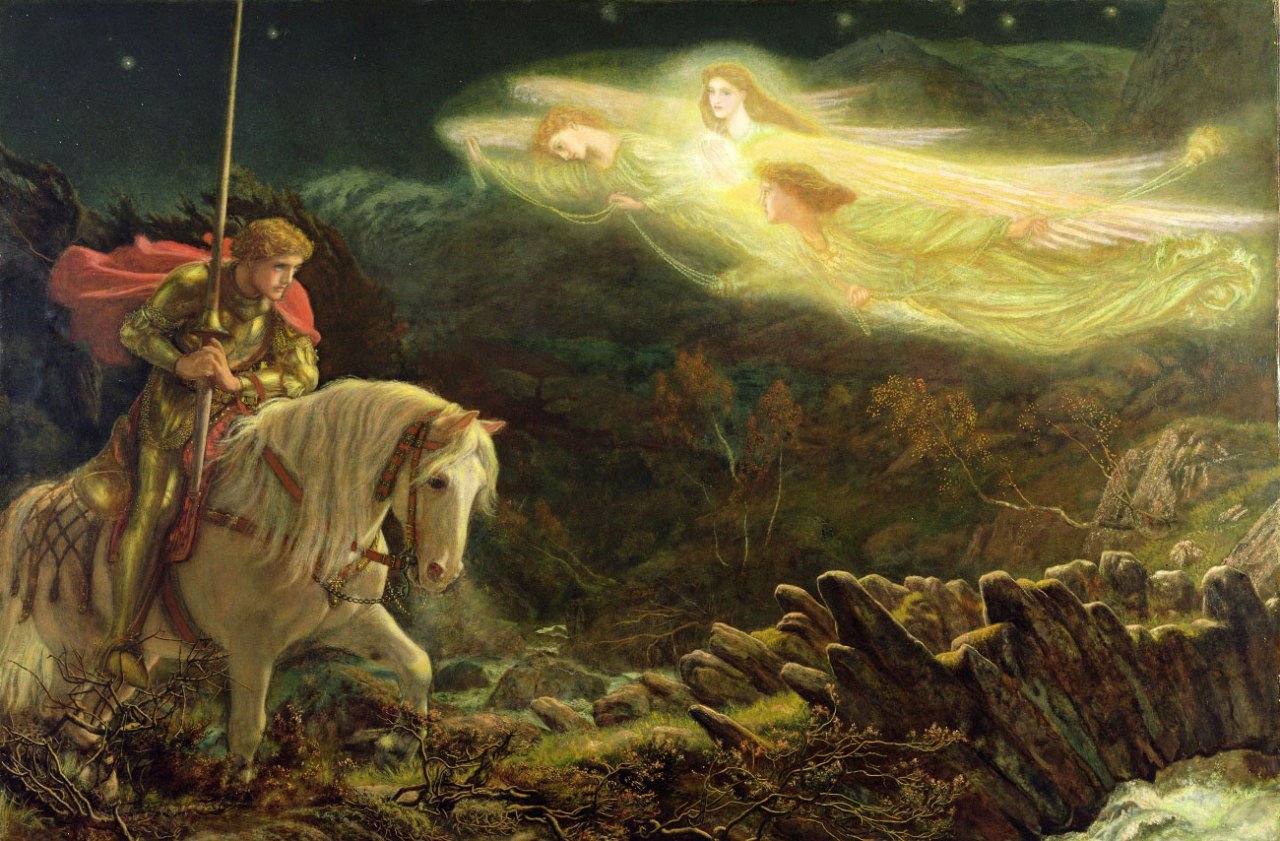
"Sir Galahad", Arthur Hughes Arthur Hughes (1832 - 1915), English
"Never shall man take me hence but only he by whose side I ought to hang; and he shall be the best knight of the world."
The youth, the desire for action, for proving himself, for leadership and change are just some of the characteristics of what could be seen in the proactive, extroverted, passionate and risk-taking knight. The passionate knight is in all our adventurous, big-hearted, passionate, charismatic, igniting heroes. His passionate desire, his youthful glow, his deep conviction and willingness to take leaps others do not take are so magnetic that very few can resist their influence.
This knight also loves the adventure and motivates others to join him. It is not rare that many are suspicious of his sometimes, unreasonably brave pursuits, but once he proves himself able to almost perform a miracle, he gains the trust. It is typical for this type of knight, that once he completes his adventures, he settles down into calmer life, becomes a king who rules with the same charisma and fire but with more maturity in his veins. He is often a generous and kind father figure. His retreat into calmer life may also be expressed through his dedication to religion and God, as it is the case in the knightly stories of previous times. He is our knight of wands, of the elemental fire.
When thinking of an example for this inspiring hero, the first to come to mind is Galahad. Galahad, the son of Lancelot is tested from his very young age. Upon his arrival in the Court of King Arthur, an elderly knight points at an empty chair. It was prophesied that only the one who is to succeed in the quest of Holy Grail would be able to sit there without any terrible consequences. The young Galahad passes the test.
There is yet another test for the young knight - he has to take a sword on which the words from the beginning of this chapter are inscribed. Galahad is once again, successful. Brave and empowered by his skill and ability, he takes the initiative to begin the search for the Grail. The other knights accept his leadership, many of who have lost their earthly lives in pursuit of a spiritual end. Finally, Galahad is able to see the Holy Grail. Upon seeing the Grail and experiencing glorious rapture, he is taken into heaven, and it is said that no other knight will ever be capable of taking the Grail.
While life for this knight may seem easier than that of others, it is not without challenges. This knight has to go through many tests to prove his worth and the he is able of being a leader. Others depend upon him so there is a great burden he takes upon. The constant admiration and accomplishment tests him as he must resist becoming vain or tyrannical. He, in his own way, has to defeat many outer and inner demons on his path to the true meaning of life.
The Knight of Pentacles
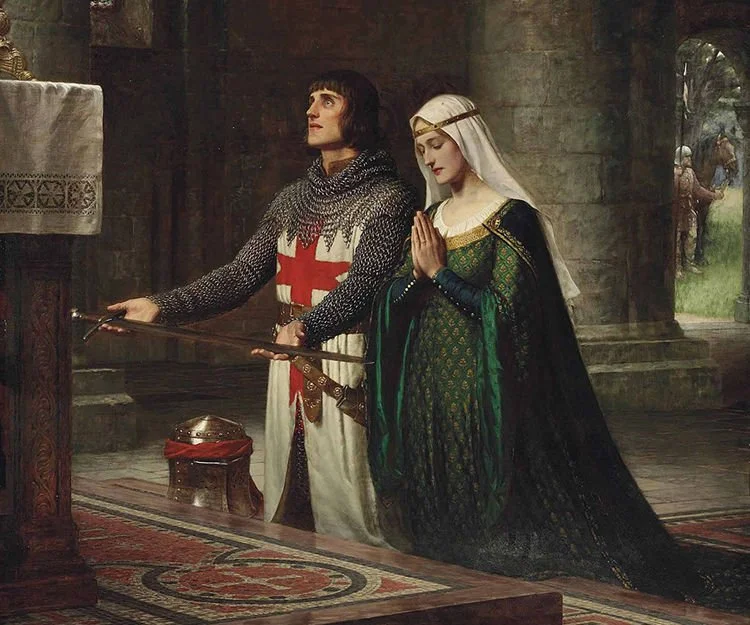
"The Dedication", Edmund Blair Leighton (1852 - 1922), English
He is resourceful, formidable, grounded, skilled, enduring, practical and reliable. Those would be the characteristics of the knight who is an ambitious builder and who builds with steadiness, clarity and without taking too many risks. He is the one to who probably, all others go for advice when they need a practical, grounded and realistic advice that will allow and help them to see their dreams become reality. He is the provider and builder, providing both spiritually and materially.
He calmly creates the opportunities for others to step in. He is private, introverted and dutiful. He may not see anything particularly heroic in his acts — he is simply being dutiful. He is practical, ambitious, consistent and often conservative. His challenges are that he can often be too stubborn, greedy, selfish, controlling and immovable. He may appear to be an enemy, a father or a teacher that a young hero must "overthrow" in order to strive as in his conservatives he may not be willing to allow any kind of change and renewal to happen. He is our knight of pentacles, of the elemental earth — consistent, humble, reliable, supportive and patient.
There are many versions and different accounts of his character, but perhaps, Gawain is a good example of this type of knight. Most commonly, Gawain is the defender of those in his community, friend of the younger knights and their protector. In a version by Geoffrey of Monmouth, he prefers courtliness to battle. In some other sources, especially the French, he is known for his dutifulness and conduct. He does not provoke or seek recognition, he does everything out of a personal sense of duty. Some French romances of Vulgate Cycles portray his flaws but they seem to be exactly the potential drawbacks of an unconscious dutiful knight — the source of one’s virtue are also one’s potential vices. so his supportive and humble nature can also make him rigid and stagnant.
Lancelot is often praised as a better knight, since Lancelot follows the spirit of knighthood, while Gawain only follows the rules blindly, without spirit. In many of these romances, he is portrayed as practical, dutiful, proud, but his lack of perception, personal emotion or passion happen to be his failure. He is unable to use God's grace, despite his noble, charitable and virtuous intentions.
This is his greatest challenge to overcome. He can be so attached to following rules and being dutiful, that he often cannot see and wishes not to see beyond that. He becomes small, narrow and blind. And he is content as such. However, in his balanced mode, he the much-needed advisor, defender, opportunity creator and provider — the way he remained in Scottish and English version of his story.
There could probably be many more examples of the knightly archetypes, but the four tarot archetypes give us a unique perspective to take in order to understand them, connecting them to the primordial elemental forces that shape our outer and inner cosmos.
