The Swan King
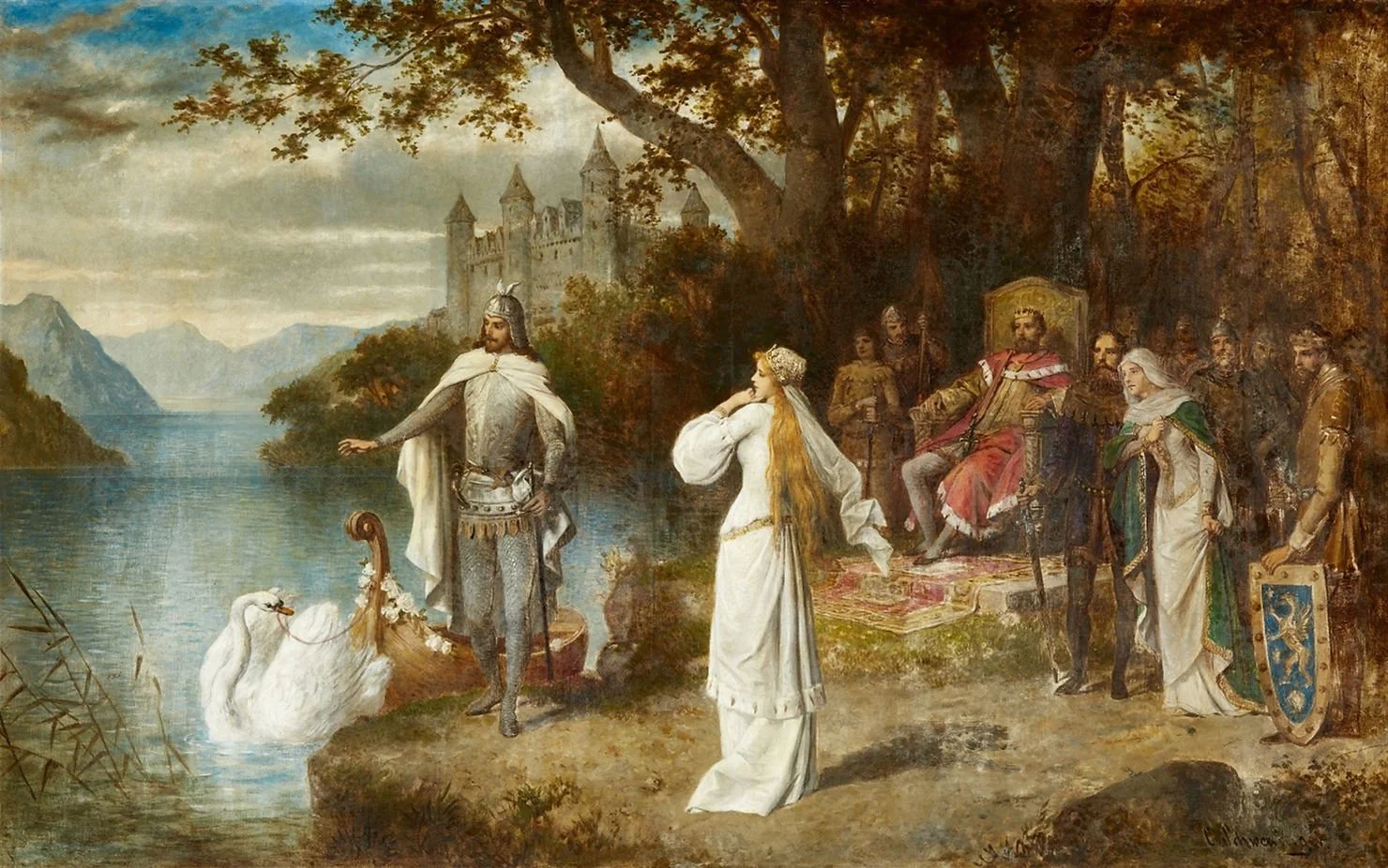
"The Arrival of Lowengrin", Carl Schweninger the Younger (1854 - 1903), Austrian
"I wish to remain an eternal engima to myself and others." - Ludwig II of Bavaria
Fairy tale castles amid Bavarian forests, Germanic mythological role, swans and Wagner's operas — those are the associations with the tragic and sometimes described as mad, King Ludwig II of Bavaria. A reluctant ruler and avid dreamer, his legacy turned out to be his enormous dreams.
This article aims to explore the subtleties and eternal principles that speak to us through someone like him.
Biographical Moments
Before we begin with subtler, symbolic domain, it is useful to learn a few biographical moments of the person from whom we learning today.
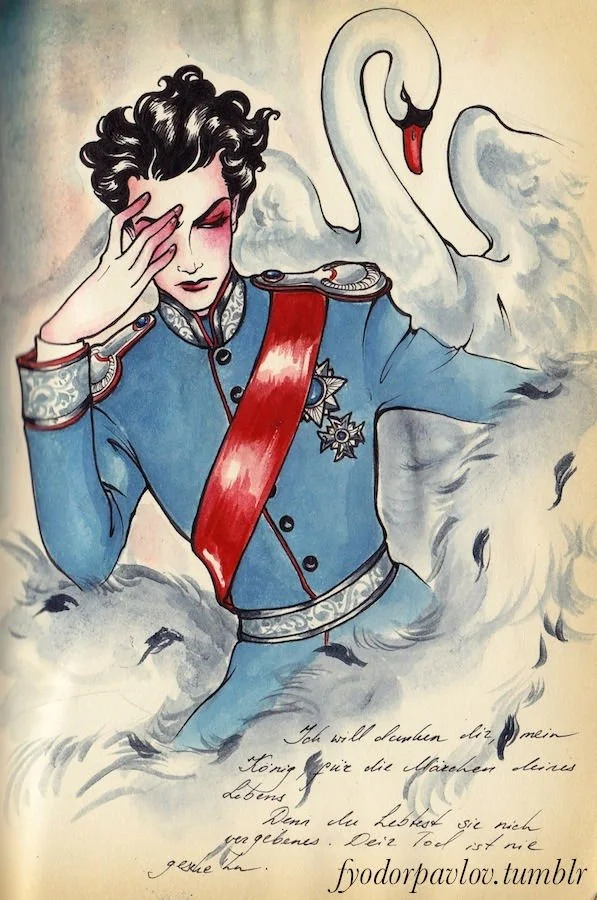
Ludwing II of Bavaria, Fyodor Pavolv
Ludwig Otto Friedrich Wilhelm was born on 25th of August 1845. He ruled his kingdom, Bavaria, for 22 years. He came to his throne at only 18 years old in 1864, and ending it, with his death, in 1886. Young, artistic, dreamy, sensitive and idealistic, he had to act against his romantic inclinations from the very beginning. It was only for two years that he ruled when Prussia decided to attack Austria and Bavaria. The war was an easy victory for the Prussian forces, forcing Bavaria to sign mutual defence treaty with Prussia. That was not the only war that he had to fight. Another war came in 1870, the war between Prussia and France, in which Bavaria sided with Prussia. The victory, was once again Prussian and Bavaria, although with some autonomy, became a part of the German Empire.
Many wars prevented the young King from bringing his romantic visions to fruition. As the time passed, Ludwig was getting more and more distant from the state affairs. He almost completely withdrew from his duties in favour of his artistic projects. It is often mistakenly thought that it was the state funds he used to see his fantasies materialise — it was in fact his royal revenues and borrowed money that he used for them, never the money that belonged to the people. His ministers repeatedly tried to restrain him, but he was not to give up his fairy tale. His extravagant interests were used against him to declare him a madman, an accusation that has been questioned by historians.
His death was and still is a great mystery. One June afternoon, while in a mental hospital, Dr. Gudden accompanied Ludwig for a walk in the grounds of the Berg Castle. After dinner, Ludwig wanted to take another walk, through the parkland and Lake Starnberg. Some accounts suggest that the walk was actually the doctor's suggestion. The doctor insisted they go alone and that no servants or aides follow them. They were last seen at six thirty in the evening and the return was expected at eight. Neither of them came back at the expected time. The searches lasted for two hours until finally, at around ten and thirty, they found bodies of the both men. The King's watch stopped at six and fifty-five.
Officially a suicide, there are other claims regarding his death. Official autopsy indicated no blood in his lungs, and he was not considered suicidal at the time. Actually, Dr. Gudden had positive remarks about his mental health. Doctor's body showed evidence of blows to the head as well as some signs of strangulation. There is a speculation that his enemies attempted to kill him during his attempt of escape from the Berg.
The Archetype of the Reluctant King
It may be that life imitates art or that art imitates life, but both in fiction and in historical accounts, we find the archetype of a romantic and therefore reluctant king. He appears in many unique forms.
Sometimes, he finds it that his soul is not that of a king but of an ordinary man, an everyman, a farmer who just wants his warm hearth, a healthy maiden and a plenty of children. His ministers usually either do not trust him or see him as a man uninterested in the state affairs, and therefore, a wonderful marionette for that one particularly ambitious minister. Sometimes, he is a hedonist, a man sick of responsibilities, courtly orders, protocols and duties. He lives lavishly, spending his time in taverns or organising extravagant parties at his place. He spends excessively. He is sometimes feared, since he can be very unkind towards those who stand between him and his pleasures. And then there is the one with lavish fantasies and ideals, an artist and a dreamer, a romanticist with a capital R, who is not very excited about politics, but once in power, sees chance for his visions to come true. He wishes to spread the ideals of beauty and romance to those around him, only to be disillusioned with the fact that others around him do not care or understand. He withdraws to pursue his love of poetry and fine art, leaving those around him in a state of great anxiety.
The common characteristic of all of them is that they do not fall under the ideal of the King archetype who is protective, firm, consistent, reliable, generous, devoted and benevolent. This ideal king is the one who ensures material abundance to his people. He is a good father to his children and a loyal husband to his queen.
The reluctant King is often a son of a more kingly father, perhaps the one who has brought about prosperity to his people or the one who managed to help his people during a crisis. The son who is to become a reluctant king is not so rarely the one who inherits the state in the relatively good conditions. Since young age he was told that he is to be a king, taught in skills necessary for one — and very often, under this pressure, he becomes alienated not only from his parents, but the role of the King itself.
One may wonder, why is then that we enjoy reading and seeing stories about such kings? What is it that draws us to stories akin to “Emperor's New Clothes” or the stories of mad kings and queens? Why is Ludwig II Bavaria's most well-known and most beloved monarch? Perhaps a part of us enjoys seeing that the powerful, semi-mythological beings such are monarchs are but humans of flesh and bone. It is also very probable, that we, reflecting our own moral battles, love to see the ways in which power corrupts. We come to see the burdens and challenges of power and prosperity, not only its enviable parts. And finally, a Romantic may say that behind the splendour and the great legacy of long dynasties stands a great fragility, and that fragility is personified in the king who does not want to be a king. Beauty, prosperity, loftier ideals being fragile in nature. Decay and transience are those themes that eternally fascinate the Romantic spirit.
Our fairy tales are full of kings and queens, princes and princesses, knights and maidens because monarchies and dynasties are fragile and that is perhaps the most fairy tale characteristic of them. A reluctant king, a mad king, the one who pushes the first domino before they all collapse is a living evidence of that. He is the kingdom at its peak of prosperity but that peak is also the beginning of its decay. A beautiful walk into the red of sunset. Sensuous, lush, perhaps more beautiful than ever, yet at its dying hour.
Fairytale King, Swan King and Patron of Aesthetes
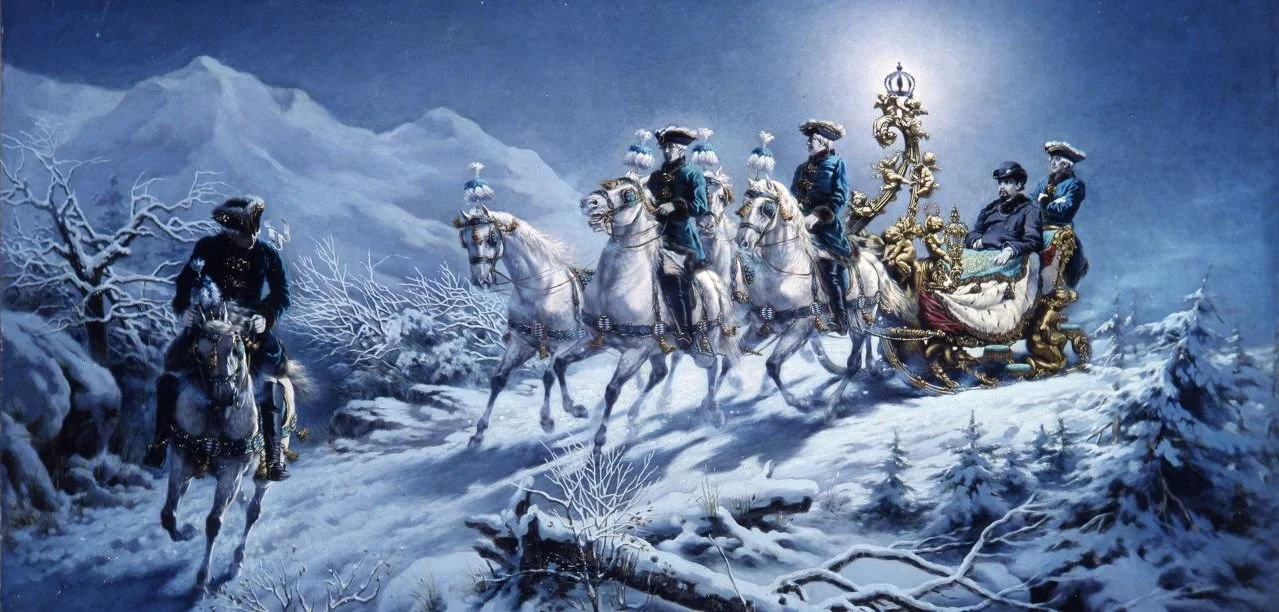
"Ludwig II on a Night-Time Sleigh Ride", Karl Wenig (1830 - 1908), Russian
Ludwig earned two other names, besides the ones given to him at his birth — one of them is a "Swan King" and the other is der Märchenkönig, which translates to "The Fairy Tale King".
The king was only fifteen when he first saw "Lohengrin", a Wagner's opera inspired by the medieval German romance. It embodied the notable Knight of the Swan legend — a mysterious knight who comes in a swan-drawn boat to rescue a damsel. "Lohengrin" never left Ludwig's heart, him continuing his love of swans and keeping swan figures and paintings in his castles. Very often, the King was painted himself as a Knight of the Swan. Wagner's operas inspired the fantasy loving Ludwig.
Ludwig is considered the saviour of Wagner's career, welcoming him to his Court and giving him an opportunity to perform before audience in Munich. Even though nobody could come close to Wagner, Ludwig introduced Mozart, Ibsen, Shakespeare, Schiller, Corneille and many others to the Bavarian audience. Sharing the Romantic vision that the arts had power of salvation, he was deeply convinced in its transcendental powers.
The name "Fairy Tale King" is hardly a mystery. His fairytale castles, built for no other purpose than to live a fairy tale, his pursuit of fairy tales and desire to make world, a fairy tale brought him that name. He was not someone who only enjoyed the fairy tales as a pasttime, he lived his fairy tale and he brought the fairy tale to the world.
As a believer in transcendent power of beauty and arts, Ludwig has become patron of aesthetes and dreamers everywhere. His great vision of beauty and art was not a vision of beauty which is nothing but eye pleasantry. His vision of beauty tells a story of humans, of gods, of possibility, of that which is available, and we do not think it is. It is a story in which white castles on a mountain hill are ours and Swan knights are us. His castles which stand tall and inspire an awe to anyone who places an eye on them, stand as a reminder that Ludwig and those like him do not come to this world as rulers, but as those who point a finger towards a meaning, the transcendent, the beautiful and the good. They allow us to join them, for a moment, in their fairy tale. His dream in the end, did come true - years and years after his death, his castles inspired the modern fairy tales world of Disney and his life and death, remained an enigma just like he wished.
"Alas, he is so handsome and wise, soulful and lovely, that I fear that his life must melt away in this vulgar world like a fleeting dream of the gods." - Richard Wagner
