The Renaissance of the Body
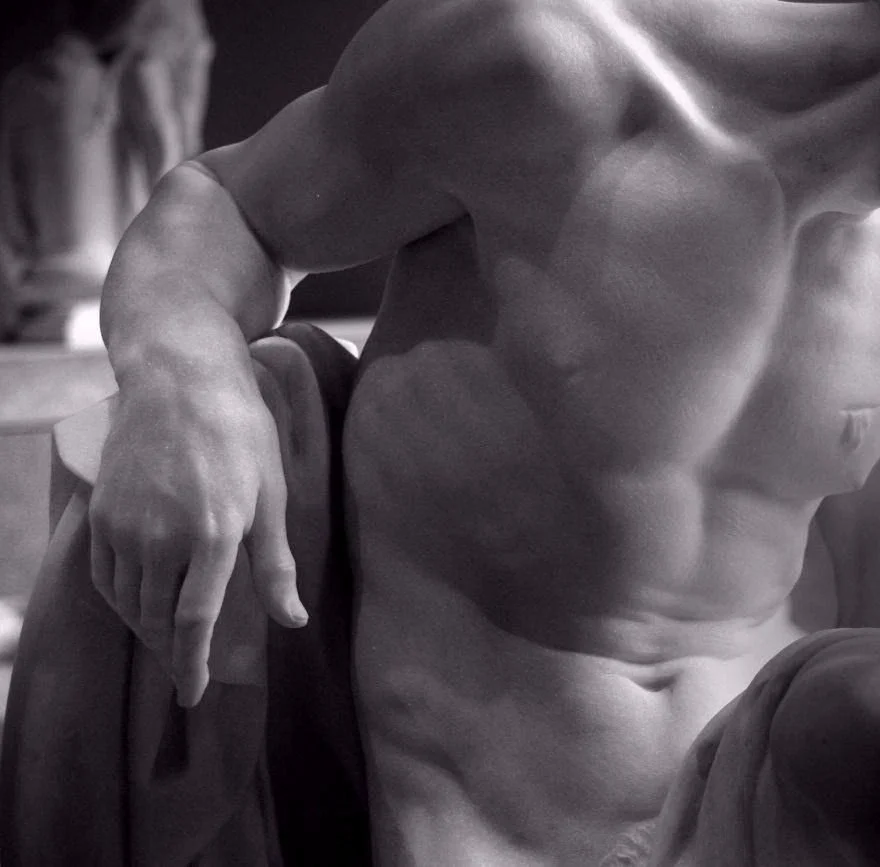
"Dying Gladiator", Pierre Julien (1731 - 1804), French
"A girl stood before him in midstream, alone and still, gazing out to sea. She seemed like one whom magic had changed into the likeness of a strange and beautiful seabird. Her long slender bare legs were delicate as a crane's and pure save where an emerald trail of seaweed had fashioned itself as a sign upon the flesh. Her thighs, fuller and soft-hued as ivory, were bared almost to the hips, where the white fringes of her drawers were like feathering of soft white down. Her slate-blue skirts were kilted boldly about her waist and dovetailed behind her. Her bosom was as a bird's, soft and slight, slight and soft as the breast of some dark-plumaged dove. But her long fair hair was girlish: and girlish, and touched with the wonder of mortal beauty, her face. She was alone and still, gazing out to sea; and when she felt his presence and the worship of his eyes her eyes turned to him in quiet sufferance of his gaze, without shame or wantoness. (...) - Heavenly God! cried Stephen's soul in an outburst of profane joy. (...) A wild angel had appeared to him, the angel of mortal youth and beauty, an envoy from the fair courts of life, to throw open before him in an instant ecstasy the gates of all the ways of error and glory. Oh and on and on and on”
- "Portrait of the Artist as a Young Man", James Joyce
The transcendental experience of beauty described through the eyes of Joyce's hero is not at all, new or unique to this specific work. Symbolism as a literary movement carried within itself idea that things and objects are a source of abstract revelation. Similar sentiment to the one described in the above mentioned excerpt from Joyces's book, can be found in Rainer Maria Rilke's "Duino Elegies". "Who, if I cried out, would hear me among the Angelic Orders? And even if one were to suddenly take me to its heart, I would vanish into its stronger existence. For beauty is nothing but the beginning of terror, that we are still able to bear" says he in the dramatic opening of his monumental piece. This experience of the great all-consuming beauty is a portal to Dionysian depths where the differences, distinctions, reason and ego dissolve. The terror that accompanies it is the terror of the dissolving ego who is that part of us always desires to be separate and yet as it "vanishes into stronger existence" of the experience, it faces its own fragility.
However, the reason why this essay opens with this specific quote is because in it, the source of revelation is a body, more specifically the body of another, of a woman.
Much of the cultural, philosophical, political and ideological discourse in Western (but not only Western) thought is defined by the opposing polarities. This framework enveloped the body as well. Finding its root in Cartesian dualism, the dualism between body and spirit or body and mind appears to be so deep in the cultural subconscious that no matter in which direction the cultural paradigm shifts, the result is the same — body is left abused, defiled and demonised. The mystery of incarnation is the terror for the secular mind.
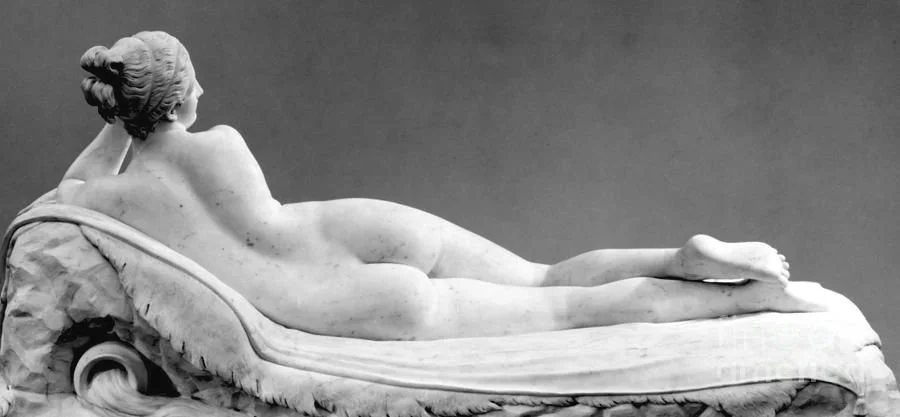
"Reclining Naiad", Antonio Canova (1757 - 1822), Italian
Renaissance saw a celebration of the human form. Even though it was often disconnected from the body’s sacredness in a religious sense, the Renaissance mind could find some mystery and divinity, albeit in directly, in the way it functions and work. This fascinated the scientific spirit that was being born at the time. The Neo-Classicists of 18th century were also drawn to the simplicity and symmetry of Renaissance and Classics. Regardless of the artistic movements and trends, what seemed to have happened over the period of time is that body was left out of any profound, holistic and organic philosophical idea — after having being seen as the locus of Holy Spirit in the Christian thought or as an evidence of cosmic, divine craftsmanship, the 17th century saw the body conceptualised through the Descartian idea of the "human machine". The vocabulary that surrounded the body became the vocabulary fit for a machine — fuel, pump, function. While possibly useful in the realm of natural sciences, when made part of one's internal linguistics, it drives one to relate to their body in this way as well. Body is then, simply a machine that has a certain function. It rouses no amazement and it is no source of revelation.
Dualism, Duality and Pythagoreans
Even if one is a philosophical Non-Dualist or Monist, it may be difficult to ignore the argument, that in nature and material realm, there are visible dualities (even if they are not separate as principles) — night and day, left and right, cold and hot, dark and light, female and male in the world of plants, animals and humans. There is subtle difference between philosophical and metaphysical dualism and recognition of duality that still holds an internal unity and coherence.
Early Pythagorean thought was defined by strict dualism, or opposition between principles. They went as far as believing that when two opposites are in contrast, only one of them represents the perfection, while the other one is erroneous and evil. Later Pythagoreans like Architas, under the influence of Heraclitus, abandoned the idea of strict oppositions and disharmony, and embraced the idea of equilibrium between opposites which results in harmony. Harmony, is, then, achieved, not by removing one or the other, but in letting them be in harmonious, complementary and creative tension. This principle, on the level of visual expressions, translates into symmetry — one of the core principles of classical art.
"Now as principles are neither equal nor of the same sort, they could not have been ordered into a cosmos without the addition of harmony, regardless of how it be added. If principles were similar and of the same sort then there would be no need for harmony: but those elements that are dissimilar and of different sorts and diversely ordered must allow of envelopment by harmony, which can hold them firmly within a cosmos." ("Fragmets of the Pre-Socratics, Philolaus)
Following the logic of this excerpt, one can say, that for a Late Pythagorean, beauty of human body would be expressed in the harmonious relation between the different parts of the body or face. Symmetry was the harmonious law of the cosmos for Pythagoreans and human beauty was more perfect the more it reflected that same law.
Body as Revelation
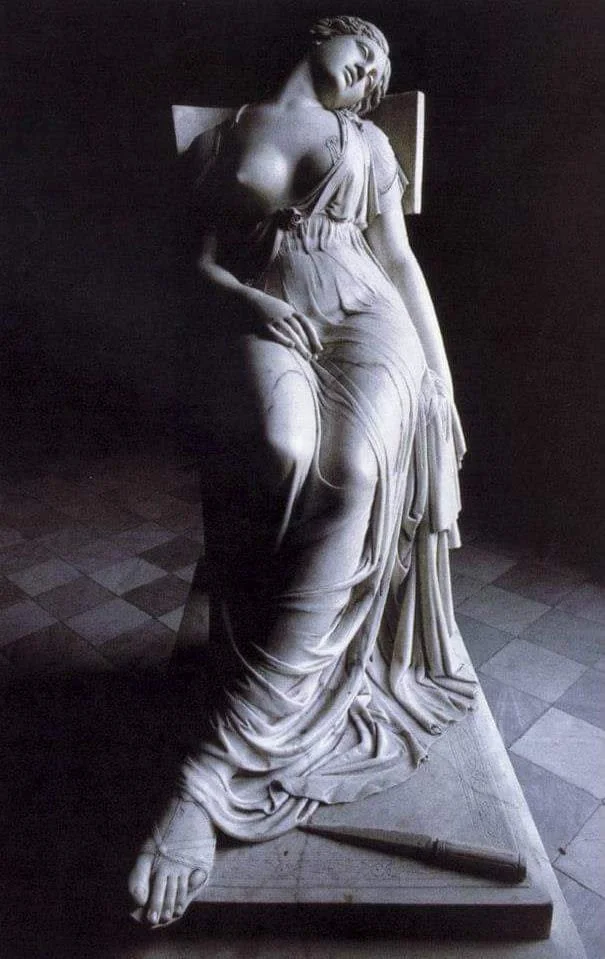
"The Dying Lucretia", Damián Campeny (1771 - 1855), Spanish
Joyce's hero, Umberto Eco's monk in "The Name of the Rose" tormented by guilt for his sin, hundreds and hundreds of poems written, all whisper, that in the specific moment in which they felt overpowered by passion, they felt the presence of something greater than themselves. Desire itself pointed to the desire for the experience of God in flesh, brimming in one’s being.
What sets apart all of those experiences from an experience of mere arousal is a moment of contemplation and awareness — heart too is present, not just the loins. At that specific moment, the protagonist or the one singing a poem of his or her experience stops and distances from their heat in order to contemplate the divine beauty of their beloved. They Other becomes the locus of theophany.
In that moment, the Other is not just an object of one's desire, a thrill of life or a mere biological pull towards reproduction but rather the very personification of the "Song of Songs" or Rilke's powerful angels. Only once they had been taken into Dionysian depths, do the Apollo's potent rays shine and suddenly, the object of one's desire is transformed into a source of heavenly, divine light. The darkness of Dionysus has become locus for the light of Apollo, the terror disappears and one bathes in light.
"That which menaced
Is now seduction.
That which frightened
Is now pleasure.
And the bites of panther and hyena
Are new caresses
And the serpent’s sting
Is but a burning kiss.
And thus the universe resounds
With joyful cry
I AM!
- "Poem of Ecstasy", Alexander Scriabin
