The Michaelmas
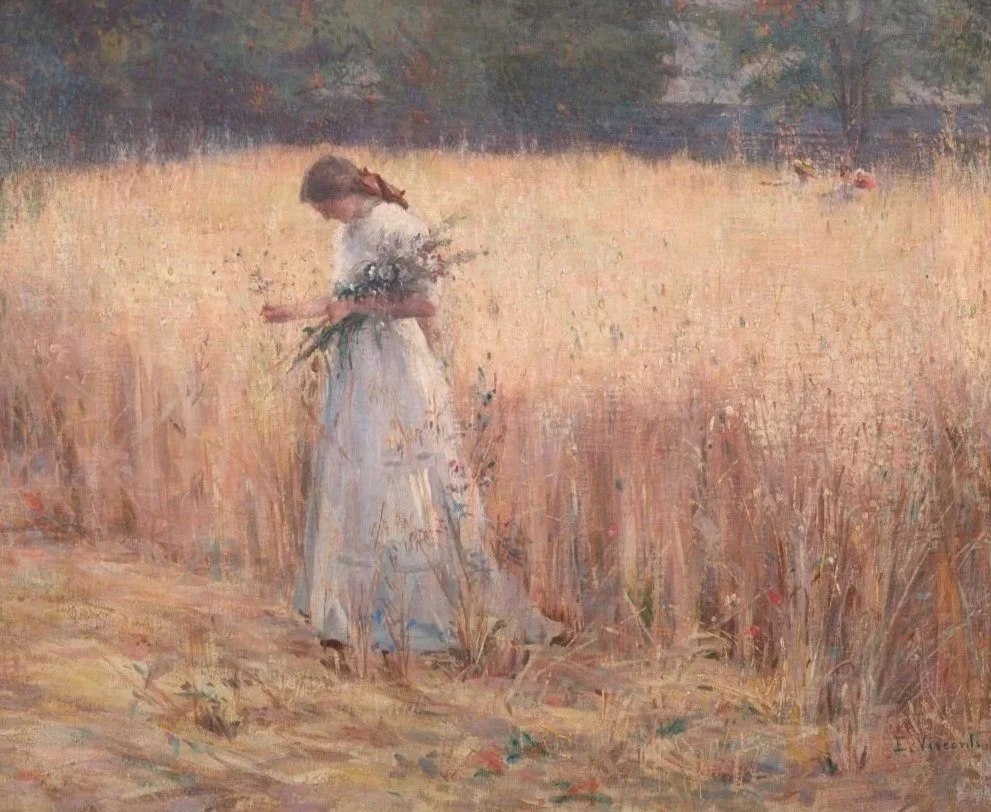
"Girl in the Wheatfield", Eliseu Visconti (1866 - 1944), Brazilian
Lyric night of the lingering Indian summer,
Shadowy fields that are scentless but full of singing,
Never a bird, but the passionless chant of insects,
Ceaseless, insistent.
The grasshopper's horn, and far off, high in the maples
The wheel of a locust slowly grinding the silence,
Under a moon waning and warn and broken,
Tired with summer.
Let me remember you, voices of little insects,
Weeds in the moonlight, fields that are tangled with asters,
Let me remember you, soon the winter will be on us,
Snow-hushed and heartless.
Over my soul murmur your mute benediction
While I gaze, oh fields that rest after harvest,
As those who part look long in the eyes they lean to,
Lest they forget them.
— “Indian Summer”, Sara Teasdale
Aromatic evenings with a scent of burnt hay. Low, powerful, striking sun that blinds. Golden shadows are cast by rivers and ponds. Swarms of insects. Light breeze that usually accompanies the sun, teases and playingfully cheats one's senses — the sun is stronger than it is made feel by the breeze.
In my mother language, translated, we call this Michaelmas Summer. The Michaelmas, the feast of Saint Michael, Raphael and Gabriel, is celebrated on 29th of September, but the season of the extended light and warmth expands beyond it, sometimes as far as early November. This season, however, of "prolonged" summer, and unusually warm and dry days during September, October and November, has different names in different languages. Indian summer is the most common name for it in English, but other languages have slightly different names.
One of the most common names for it is, in translation "Old Woman's Summer" - German ("Altweibersommer"), Slavic languages ("Babí Léto", "Bablje Ljeto"), Finnish ("Vananaistesuvi”). Others name it after Saints, like Saint Martin's day in Netherlands, Saint Teresa of Ávila in Spain. The mild, temperate parts of Southern Hemisphere like Brazil, Argentina, Chile and Uruguay also have the name for it and they call it "Veranico", "Veranito", "Veranillo" and it occurs during April and May.
There is something romantic, melancholic about this season — the passing of time, the departing of summer and knowledge that no matter how long the sunlight and warmth stay, the cold, dark winter days are around the corner. The usual companions of the summer, the birds and the plants, the buzz of life through an open window are slowly leaving, and despite the potent sun, there is the inner awareness of change, of the upcoming silence and frost of the winter. Those are the last days to enjoy the sunny outdoors, to feel nature alive, to feel the sun that is gentler than it was in July. Sun no longer burns. Its rays offer the healing embraces of Apollo.
Beyond everything else, what this time of year reminds us the most (and maybe, the reason why autumn is so often a favuorite season of painters, poets, wirters and philosophers) is the passage of seasons and passage of time. The melancholy that comes with awaraness of this, of time, is awareness of the stern and strict father Saturn who devours everything. Even his own children are not spared. The passage of time is also a reminder, of Lord Krishna's words in "Bhagavad Gita": "Time I am, the great destroyer of the worlds, and I have come here to destroy all people" (11.32).
Time constantly destroys in order to create and our human bodies, including our identity constructed around existence of our own individual "I" is not spared. The seasons that pass, liberate us as they devour us. They liberate us from the self-absorbed mode in which, all of us, on daily basis, exist.
The seasons do not stand only as a reminder of the cosmos that constantly destroys and constantly creates on the very ashes and corpses it created yesterday. The awareness of seasons presents before us both the cycle and the spiral. The eternal movement, the cycle that is yet always new and never truly repeated.
Whether it we view this in a certain, big, cosmological view, or whether we view it as our own, internal springs, summers, autumns and winters, what one learns is that every season, has its fruit. A bad winter, is almost always a guarantee for a bad summer and finally a bad harvest. The cold and contemplative winter prepares the soil for everything that happens after it. The seasons are cyclical and in their generalities always the same, and yet in their specifics, always different. No winter or summer is like the other winter and summer.
Harvest festivals, equinox and solistice festivals are familiar to humans across cultures and religious traditions. Eating seasonally—only that which nature offers at specific time of the year—has been, and still is, practice in many corners of the planet. In our time, when any kind of food is available at any time and when winters no longer seem like a hardship to get through and prepare for, we have been afforded the luxury to put aside the rhythms around us. Aliens to external nature, we are also aliens to our own, internal natures.
But it is not just romantic connection with the Virgin Nature that has been broken. Alienation from cycles, seasons and festivals is alienation from Time. In particular, alienation from the unique relationship between human and time. "Sometimes,' my father used to say, "I am moved to found a festival; but it is not so much a festival I found as a set of relation between Man and Time", says Antoine De Saint-Exupery in his "Winds, Sand and Stars", pointing the extraordinary, transcendental component of the relationship between humanity and time.
Festivals and seasonal rituals allow humans, as Mircea Eliade suggests in his work, to leave for a moment, ordinary time and enter the realm of a sacred, great time. Time is experienced as a cosmological rhythm. Through a festival, time is a circle that also opens itself to the verticality, that is, eternity. Such, time becomes a spiral, allowing for evolution to occur.
To return to the little lyric prayer offered by Sara Teasdale and its message — do remember to pay attention, to listen, notice and observe Notice seasons as they come and go. Establish relationship with Time. Experience the infinity of the Self.
