The Gentle Hedonism
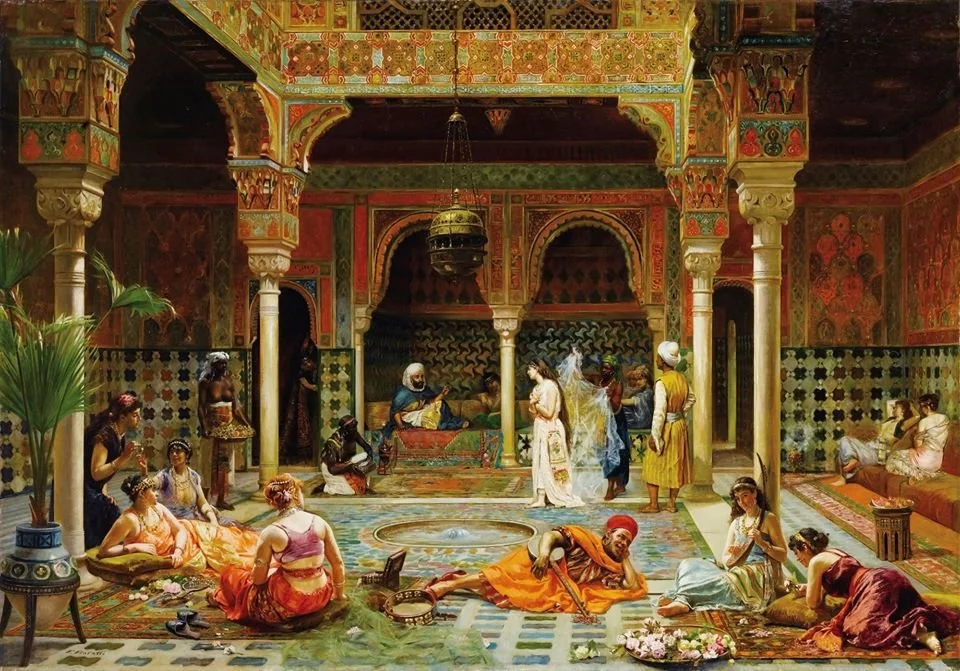
"The New Favorite", Filippo Baratti (1849 - 1936), Italian
Hedonism is a powerful word that, depending on an individual, can cause for one's pupils to widen or to pass puritan judgements of how pursuit of any pleasure, even the most innocent one, is a distraction and should be looked down upon. The many different attitudes between the Epicureanism and theological dualism in the Western cultural sphere have probably in either case, developed, what in my view appears to be an unhealthy attitude towards sensory pleasure and enjoyment.
Between Blind Indulgence and Puritanism
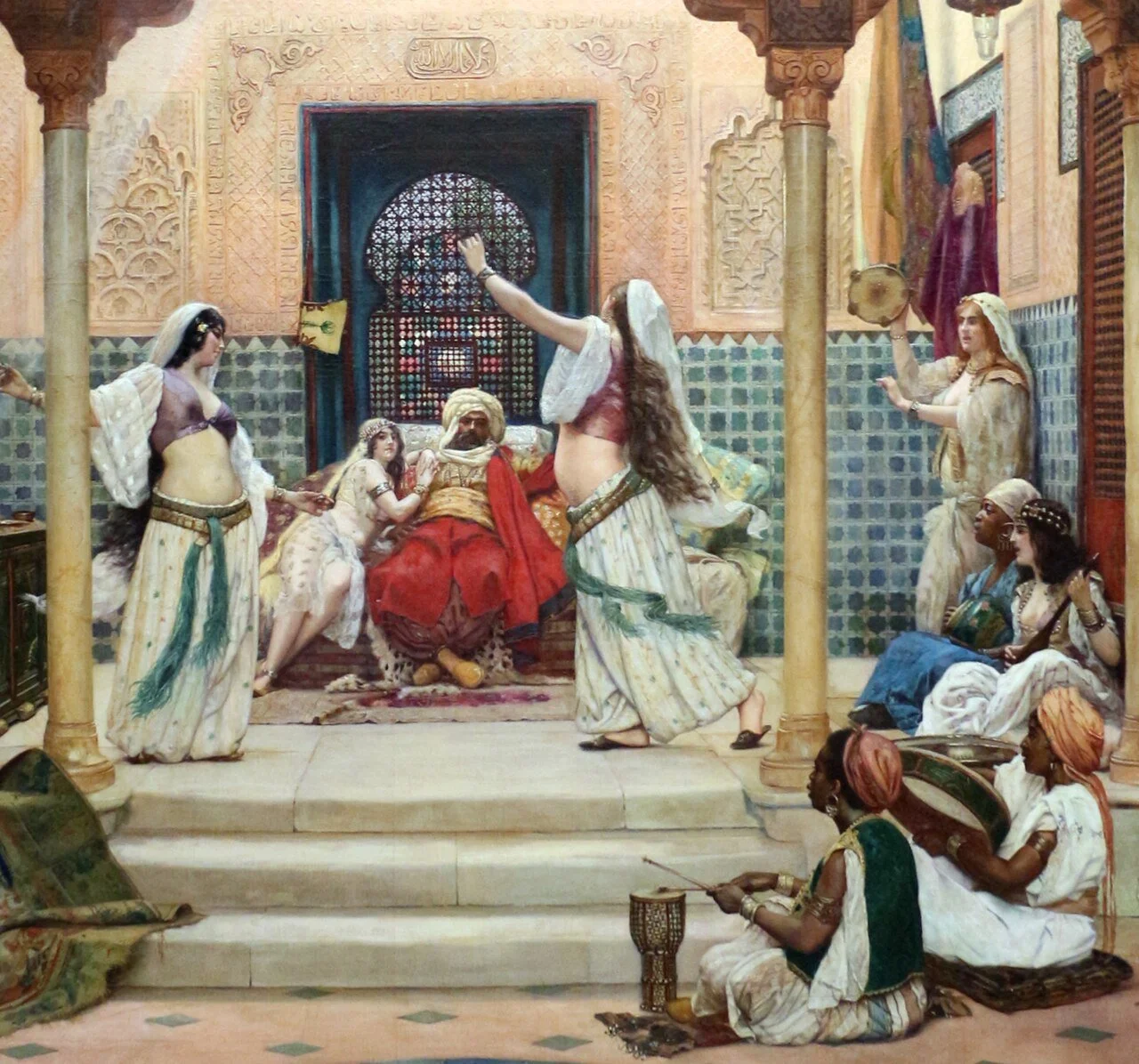
"Les Almées", Paul Louis Bouchard (1853 - 1937), French
Epicurean philosophy was founded by the Greek philosopher Epicurus. It rose as a challenge to Platonism and later Stoicism. Epicurean hedonism during the ancient period was slightly different than what we come to define as Epicurean attitude in the modern age. Epicureanism believed in two virtues: tranquility and freedom of fear and freedom from bodily pain. Epicureanism however does believe that pleasure is the main good in life and to bring the greatest amount of pleasure possible in one's life was worthy pursuit.
Sensual pleasure is a shiny gem before our eyes. It is difficult for to say "no" to its pleasure — be it sex, a beautiful piece of chocolate, a relaxing massage or a good steak. These pleasures do not touch only our biological needs but also bring us subtler pleasures. Thus we easily become addicted to our sensual joys. When taken to an extreme, the indulgence easily comes to look ugly to us as it very often appears that a person who is overindulgent is being ruled by something rather low, like the human quality has completely collapsed. It does not appear that it is even pleasure they are looking for but a kind of numbness. When hedonism takes its worst form, it is only natural that in the its shadow, the puritanism would also appear.
Looking at how low the indulgence can bring the person, the puritans come to another extreme where everything that is related to body is secretly hated and everything that brings joy to the senses, despised and spoken against. The architecture shall no longer be ornamented, the clothes shall be simple without decorations and body will be given just enough to live, for food is fuel of the body and not the pleasure, and sex is for procreation exclusively and not the bodily pleasure. However, the "samsaric" cycle does not end as puritanism, with its repressive ways, often once again, helps indulgence to come to life.
Stuck between these two opposing paradigms, the people of the modern Western cultural sphere cannot even conceptualise anything that is not either of the two. Neither puritanism nor hedonism needs religion or lack of thereof to exist — plenty of secular puritanism can be seen in minimalism, in attitude towards the traditional nude art, especially the nude art in which woman is portrayed as an object of a man's desire. Yet at the same time, the social media and the internet have never had more of the most vulgar representations of the human, particularly, female body. The opposition has deeply penetrated the psyche and unlearning it may take a lot of time.
Orientalism & the Western Shadow
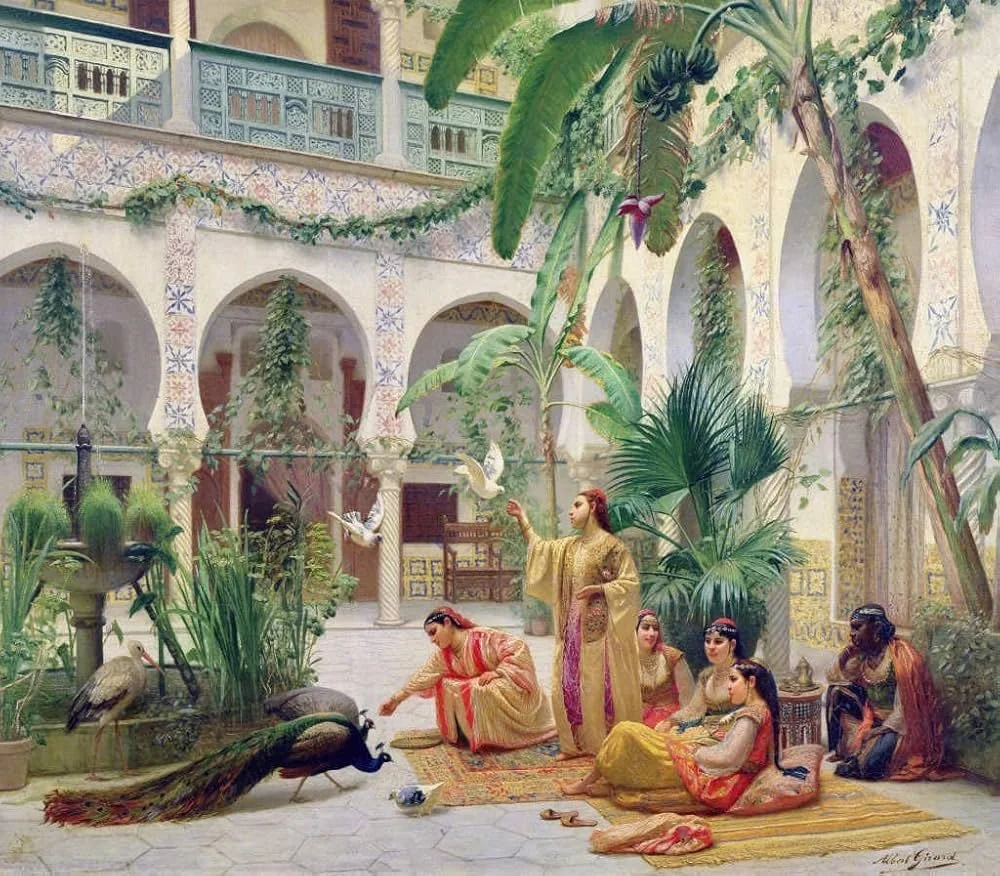
"Court of the Harem", Paul-Albert Girard (1839 - 1920), French
There was an era in Western art called Orientalism. It was an era during which the Westerners who traveled to colonies, painted, Eastern and Islamicate cultures. While a lot could be and has been said about the colonial "othering" through those like Edward Said, the focus of this text is not critical theory. While this art may be observed through the critical lens, it can also be observed through psychoanalytic or metaphysical ones too.
The Orientalist art is full of pleasures — it brims with colours, harems, people lounging in hammams, rose petals spread across the place, animals, musicians playing on the lutes, dry fruits, rose water, oils, dances. The general feeling of the paintings are extremely sensual. A critical theorist would say that this is due to fetishisation of the "other", and while it may hold true from a certain perspective, I believe it also has simply showed a suppressed but still present "shadow" of the Western psyche — the part of it that was burdened by dualism between body and soul, by Enlightenment's rationalism and Calvinist and Victorian morality. In the colorful and generally, more open towards pleasures cultures of the Ottoman Balkans, Middle East, North Africa and South Asia, they saw, even more visibly that which has been suppressed in their own corner of the world and was done "behind the closed doors."
Orientalist paintings often, did not simply show hedonism in its "decadent" way, there was elegance to it, a consciousness, the unification of Apollonian and Dionysian — another duality so dear to the modern Western mind (and often conceptualised as separate).
The Sweet and Gentle Pleasure
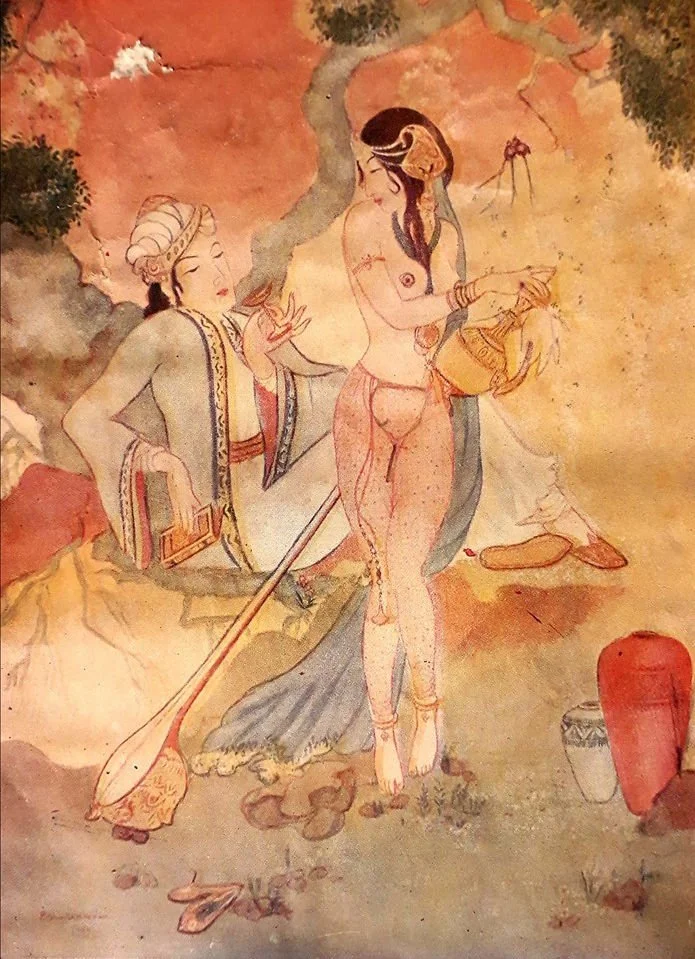
Art on the left: "Omar Khayam", Sri Bhuwan
The images that come as a personificiation of Khayyam's and Hafiz's poems in Orientalist art show another side of hedonism. In such a hedonism, one does not seek to numb himself or herself down from their feelings, but rather to intensify them. The goal is more life, more feeling, not less of it. The perfumes, the music, the beautiful interior, the sound of water in the pool — they all add to this complete sensual immersion. The pursuit of such a pleasure is not to go outside but to go deeper within, deep into the Dionysian depths of our primordial unity.
Such pleasure is itself an art. It requires a life force and vitality that can go into fire and endure. It requires a sensitivity for the subtle, the non-obvious.
Us modern people have forgotten what it is to take time for anything — to take that date, that fruit and truly devour it, feel it, to truly listen to music, to truly feel the texture, the smell of beloved's skin as we touch them. This hedonism, blessed by sacred light, serves to connect rather than alienate and if we learn it, we might heal ourselves from repression of our senses or from oppression of our souls, through the gift of senses.
